
A Comparative Study of Infiltration Capacity on Various Land Covers in the PT Semen Padang Industrial Area
DOI:
https://doi.org/10.24036/nhydzx55Keywords:
Infiltration capacity, Greenbelt area, Open area, Developed areaAbstract
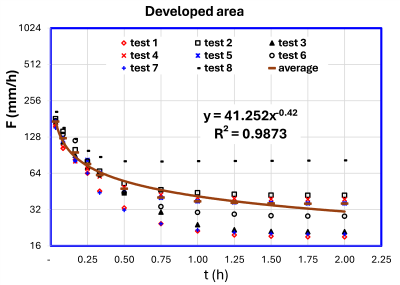
Changes in land cover within industrial areas have the potential to reduce soil infiltration capacity and increase the risk of surface runoff and flooding. This study aims to analyze and compare infiltration capacities across various land cover types within the industrial area of PT Semen Padang. Infiltration measurements were conducted using the double-ring infiltrometer method on several land cover types, namely greenbelt areas, open land, and developed areas. The data obtained were analyzed using the Horton model approach to determine initial and constant infiltration rates. The results indicate that greenbelt areas exhibit the highest infiltration capacity, with an average constant infiltration rate of 183.3 mm/h, followed by open land at 74 mm/h, while built-up areas showed the lowest rate at 35.9 mm/h. These differences are influenced by soil density, organic matter content, and vegetation root activity. These findings indicate that an increase in built-up surface area significantly reduces the soil’s ability to infiltrate water, thereby potentially increasing surface runoff. This study recommends the implementation of green infrastructure and the conservation of vegetated land to support sustainable stormwater management in industrial areas.
Downloads
References
[1] W. Błaszczak-Bąk, M. Birylo, A. Biłozor, I. Cieślak, and J. Janicka, “The Impact of Urbanization and Infrastructure Development on Local Flood Risk in Tomaszkowo: Hydrological Analysis and Spatial Planning,” Applied Sciences (Switzerland), vol. 15, no. 20, Oct. 2025, doi: 10.3390/app152010863.
[2] T. Bashar and M. Z. Uddin, “Effects of Land Use Change on Surface Runoff and Infiltration: The Case of Dhaka City,” Urban Science, vol. 9, no. 12, p. 497, Nov. 2025, doi: 10.3390/urbansci9120497.
[3] N. Indhanu, T. Chalermyanont, and T. Chub-Uppakarn, “Spatial assessment of land use and land cover change impacts on groundwater recharge and groundwater level: A case study of the Hat Yai basin,” J. Hydrol. Reg. Stud., vol. 57, Feb. 2025, doi: 10.1016/j.ejrh.2024.102097.
[4] M. F. Rizqullah, E. Rustiadi, V. B. Rosandi, and A. E. Pravitasari, “Spatiotemporal Dynamics of Land Cover Changes and Local Sustainability Index of Cianjur Regency, West Java Province, Indonesia,” Jurnal Pengelolaan Sumberdaya Alam dan Lingkungan, vol. 15, no. 5, pp. 844–863, 2025, doi: 10.29244/jpsl.15.5.844.
[5] P. Zhang et al., “Rainfall-runoff generation patterns and key influencing factors in the plain of the Taihu Lake Basin, China,” J. Hydrol. Reg. Stud., vol. 58, Apr. 2025, doi: 10.1016/j.ejrh.2025.102247.
[6] P. J. Ward et al., “The need to integrate flood and drought disaster risk reduction strategies,” Water Secur., vol. 11, Dec. 2020, doi: 10.1016/j.wasec.2020.100070.
[7] T. Widodo, A. Antariksa, F. Putra, and S. Hariyani, “Spatial Approach to Infiltration and Groundwater Level: Implications For Sustainable Settlement Planning,” Jurnal Pembangunan dan Alam Lestari, vol. 16, no. 1, pp. 15–28, Apr. 2025, doi: 10.21776/ub.jpal.2025.016.01.03.
[8] T. Andayono, M. Mera, J. Junaidi, and D. Dalrino, “Infiltration capacity based on soil geophysical constants using artificial infiltration in residential land,” Teknomekanik, vol. 7, no. 2, pp. 126–138, Dec. 2024, doi: 10.24036/teknomekanik.v7i2.31372.
[9] M. Hidayat, D. Djufri, H. Basri, N. Ismail, R. Idroes, and M. F. Ikhwali, “Influence of vegetation type on infiltration rate and capacity at Ie jue geothermal manifestation, Mount Seulawah Agam, Indonesia,” Heliyon, vol. 10, no. 4, Feb. 2024, doi: 10.1016/j.heliyon.2024.e25783.
[10] T. Andayono, “The Effect of Soil Density on Infiltration Rate in The Urban Development Area of Padang,” Jurnal Teknik Sipil & Perencanaan, vol. 20, no. 1, pp. 1–5, 2018, doi: 10.15294/jtsp.v20i1.12387.
[11] M. F. Nawaz, G. Bourrié, and F. Trolard, “Soil compaction impact and modelling. A review,” Agron. Sustain. Dev., vol. 33, no. 2, pp. 291–309, Apr. 2013, doi: 10.1007/s13593-011-0071-8.
[12] R. Pitt, S. E. Chen, C. K. Ong, and S. Clark, “Measurements of infiltration rates in compacted urban soils,” Proceedings of the Engineering Foundation Conference, vol. 263, pp. 534–538, 2001, doi: 10.1061/40602(263)41.
[13] A. Y. Nofrizal, H. Rahman, and M. Hanif, “Prediction of Seawater Flooding Hazard on Settlement Areas in Padang City as a Climate Change Impact using GIS and Remote Sensing Technology,” in IOP Conference Series: Earth and Environmental Science, Institute of Physics Publishing, Aug. 2019. doi: 10.1088/1755-1315/303/1/012025.
[14] P. Studi, T. Geologi, and T. Kebumian, “Geologi dan Studi Karakteristik Rekahan pada Batu Gamping Pra-tersier Daerah Indarung dan Sekitarnya, Kota Padang, Sumatera Barat,” Institut Teknologi Bandung, Bandung, 2014.
[15] B. Liu, X. Liu, H. Wan, Y. Ma, and L. Lu, “Long-Term Quantitative Analysis of the Temperature Vegetation Dryness Index to Assess Mining Impacts on Surface Soil Moisture: A Case Study of an Open-Pit Mine in Arid and Semiarid China,” Applied Sciences (Switzerland), vol. 15, no. 4, Feb. 2025, doi: 10.3390/app15041850.
[16] J. Song, Z. Yang, J. Xia, and D. Cheng, “The impact of mining-related human activities on runoff in northern Shaanxi, China,” J. Hydrol. (Amst)., vol. 598, Jul. 2021, doi: 10.1016/j.jhydrol.2021.126235.
[17] S. Kumar et al., “Stormwater runoff characterization and adaptation of best management practices under urbanization and climate change scenarios,” May 01, 2024, Elsevier B.V. doi: 10.1016/j.jhydrol.2024.131231.
[18] M. Trigatti, R. Perin, M. Nicolini, and D. Goi, “Stormwater quantity and quality for sustainable management of runoff in an industrial district Preliminary analysis and modelling of first foul flush effect,” 2016. [Online]. Available: www.jmest.org
Downloads
Published
Issue
Section
License
Copyright (c) 2025 Totoh Andayono, Muhammad Din

This work is licensed under a Creative Commons Attribution 4.0 International License.