
Construction Work Sequencing and Zoning Strategy for Structural Works at Summarecon Mall Bandung
DOI:
https://doi.org/10.24036/3dhzet79Keywords:
Construction Sequencing, Site Management, Zoning System, Structural WorkAbstract
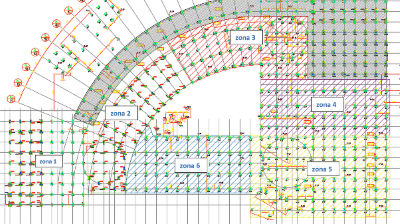
Large building projects require a construction sequence that integrates technical dependencies, site access, material flow, and crew allocation. This study analysed the implementation of structural work sequencing and a zoning system in the Summarecon Mall Bandung Phase 2 project. A descriptive case-study approach was used. Data were obtained from project documents, shop drawings, field observations, and photographic documentation produced during the 2023 construction period. The analysis identified the logical dependencies between work packages and examined how six work zones were released. The structural sequence consisted of pile driving, pile-head cutting, excavation and backfilling, soil compaction, pile-cap and tie-beam construction, column works, and beam-and-slab works. Zones 1 and 5 were started first because they did not interfere with the main access and equipment manoeuvring areas. Zones 2 and 3 followed when the first zones reached approximately 30% progress. Zones 4 and 6 were completed last because they functioned as the principal access and logistics corridors. The zoning strategy enabled overlapping activities while maintaining access, but its effectiveness depended on labour competence, material delivery, equipment availability, approvals, financing, and site coordination. The study concluded that explicit access constraints and progress-based release rules should be included in structural work-sequencing plans.
Downloads
References
[1] W. R. Mincks and H. Johnston, Construction Jobsite Management. Boston, MA, USA: Cengage Learning, 2017.
[2] O. Doukari, B. Seck, and D. Greenwood, “The creation of construction schedules in 4D BIM: A comparison of conventional and automated approaches,” Buildings, vol. 12, no. 8, p. 1145, 2022, doi: 10.3390/buildings12081145.
[3] S. Kolarić, M. Vukomanović, and A. Ramljak, “Analyzing the level of detail of construction schedule for enabling site logistics planning (SLP) in the building information modeling (BIM) environment,” Sustainability, vol. 14, no. 11, p. 6701, 2022, doi: 10.3390/su14116701.
[4] Y. Hong, H. Xie, V. Hovhannisyan, and I. Brilakis, “A graph-based approach for unpacking construction sequence analysis to evaluate schedules,” Advanced Engineering Informatics, vol. 52, art. no. 101625, 2022, doi: 10.1016/j.aei.2022.101625.
[5] M. Mayouf, J. Jones, F. Elghaish, H. Emam, E. M. A. C. Ekanayake, and I. Ashayeri, “Revolutionising the 4D BIM process to support scheduling requirements in modular construction,” Sustainability, vol. 16, no. 2, p. 476, 2024, doi: 10.3390/su16020476.
[6] Y. Jung, J. Hockenmaier, and M. Golparvar-Fard, “Transformer language model for mapping construction schedule activities to Uniformat categories,” Automation in Construction, vol. 157, art. no. 105183, 2024, doi: 10.1016/j.autcon.2023.105183.
[7] D. Kim, T. Yoo, S. V.-T. Tran, D. Lee, C. Park, and D. Lee, “Automated safety risk assessment framework by integrating safety regulation and 4D BIM-based rule modeling,” Buildings, vol. 14, no. 8, p. 2529, 2024, doi: 10.3390/buildings14082529.
[8] R. A. Machfudiyanto, T. S. N. Rachmawati, N. B. Laksono, M. Soltani, and C. Park, “Development of construction safety dashboard based on four-dimensional building information modeling for fall prevention: Case study of stadium roof works,” Buildings, vol. 14, no. 9, p. 2882, 2024, doi: 10.3390/buildings14092882.
[9] S. T. Mudiyanselage, K. Wijesundara, S. Venkatesan, S. De Silva, R. Dissanayake, and P. Neluwala, “Significance of construction sequence and the initial behaviour in concrete-faced rockfill dams,” Australian Journal of Structural Engineering, vol. 25, no. 2, pp. 125–143, 2024, doi: 10.1080/13287982.2023.2268288.
Downloads
Published
Issue
Section
License
Copyright (c) 2025 Hafizul Adib Zulyan, Nevy Sandra

This work is licensed under a Creative Commons Attribution 4.0 International License.