
Community-Based Implementation of a Waterwheel-Based Micro-Hydro Power System through Civil Water Intake Construction in Rural Agam, Indonesia
DOI:
https://doi.org/10.24036/a2qnzq58Keywords:
Civil Water Intake, Community Empowerment, Micro-Hydro Power, Renewable Energy, Rice MillingAbstract
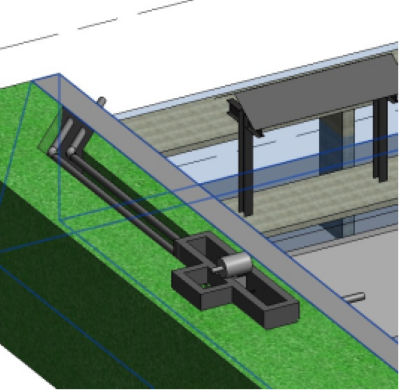
This article reports on a community service program to implement a waterwheel-based micro-hydro power system by constructing a civil water intake in Nagari Kamang Hilia, Agam Regency, West Sumatra. The program aimed to provide renewable electricity for rice milling and community street lighting, while strengthening local capacity for operations and maintenance. The implementation consisted of stakeholder coordination, field surveys, drone-based mapping, preparation of Detailed Engineering Design, civil intake construction, electrical integration, commissioning, and community training. The constructed components included an intake structure, a guide channel, a sluice gate, a trash rack, inlet and outlet channels, and a waterwheel chamber. These components were designed to regulate water flow, minimize disturbance from sediment and debris, and support stable waterwheel operation under low-head conditions. Field measurements indicated an average flow velocity of approximately 2 m/s, supporting an initial system capacity of about 5 kW. The system provides renewable electricity for productive use and street lighting, reducing dependence on costly diesel fuel and improving local energy resilience. The training activities also improved community knowledge of intake cleaning, sediment control, waterwheel inspection, and basic electrical safety. The program demonstrates that integrating civil engineering infrastructure, renewable energy technologies, and community participation can serve as a practical model for sustainable rural development.
Downloads
References
[1] W. Hermawati, K. R. Ririh, L. Ariyani, R. L. Helmi, and I. Rosaira, “Sustainable and green energy development to support women’s empowerment in rural areas of Indonesia: Case of micro-hydro power implementation,” Energy for Sustainable Development, vol. 73, pp. 218–231, 2023, doi: 10.1016/j.esd.2023.02.001.
[2] M. Rumbayan and R. Rumbayan, “Feasibility study of a micro hydro power plant for rural electrification in Lalumpe Village, North Sulawesi, Indonesia,” Sustainability, vol. 15, no. 19, 14285, 2023, doi: 10.3390/su151914285.
[3] W. W. Purwanto and N. Afifah, “Assessing the impact of techno socioeconomic factors on sustainability indicators of microhydro power projects in Indonesia: A comparative study,” Renewable Energy, vol. 93, pp. 312–322, 2016, doi: 10.1016/j.renene.2016.02.071.
[4] M. A. Isa, Y. B. Yusof, M. F. Basar, and N. M. Nordin, “Assessing the sustainable development of micro-hydro power plants in an isolated traditional village West Sumatra, Indonesia,” Energies, vol. 14, no. 20, 6456, 2021, doi: 10.3390/en14206456.
[5] S. Pratiwi and N. Juerges, “Addressing energy injustice in rural landscapes: Community leadership, indigenous villages, and micro-hydro diffusion in Indonesia,” Energy Research & Social Science, vol. 85, 102395, 2022, doi: 10.1016/j.erss.2021.102395.
[6] D. K. Okot, “Review of small hydropower technology,” Renewable and Sustainable Energy Reviews, vol. 26, pp. 515–520, 2013, doi: 10.1016/j.rser.2013.05.006.
[7] E. Quaranta and R. Revelli, “Gravity water wheels as a micro hydropower energy source: A review based on historic data, design methods, efficiencies and modern optimizations,” Renewable and Sustainable Energy Reviews, vol. 97, pp. 414–427, 2018, doi: 10.1016/j.rser.2018.08.033.
[8] P. A. Michael and C. P. Jawahar, “Design of 15 kW micro hydro power plant for rural electrification at Valara,” Energy Procedia, vol. 117, pp. 163–171, 2017, doi: 10.1016/j.egypro.2017.05.119.
[9] N. Walczak, A. Walczak, and M. Hämmerling, “Influence of debris on water intake gratings in small hydroelectric plants: An experimental study on hydraulic parameters,” Energies, vol. 14, no. 11, 3248, 2021, doi: 10.3390/en14113248.
[10] B. Poudel, J. Maley, K. Parton, and M. Morrison, “Factors influencing the sustainability of micro-hydro schemes in Nepal,” Renewable and Sustainable Energy Reviews, vol. 151, 111544, 2021, doi: 10.1016/j.rser.2021.111544.
[11] S. Rachmawatie, E. Rustiadi, A. Fauzi, and B. Juanda, “Driving factors of community empowerment and development through renewable energy for electricity in Indonesia,” International Journal of Energy Economics and Policy, vol. 11, no. 1, pp. 326–332, 2021, doi: 10.32479/ijeep.10533.
[12] A. Gunawan, A. Oktafeni, and W. Khabzli, “Monitoring of microhydro power plants,” Jurnal Rekayasa Elektrika, vol. 10, no. 4, pp. 28–36, 2014, doi: 10.17529/jre.v10i4.1113.
[13] B. Mainali and S. Silveira, “Using a sustainability index to assess energy technologies for rural electrification,” Renewable and Sustainable Energy Reviews, vol. 41, pp. 1351–1365, 2015, doi: 10.1016/j.rser.2014.09.018.
[14] S. I. Jiménez-Jiménez, W. Ojeda-Bustamante, M. d. J. Marcial-Pablo, and J. Enciso, “Digital terrain models generated with low-cost UAV photogrammetry: Methodology and accuracy,” ISPRS International Journal of Geo-Information, vol. 10, no. 5, 285, 2021, doi: 10.3390/ijgi10050285.
[15] N. Polat and M. Uysal, “DTM generation with UAV based photogrammetric point cloud,” The International Archives of the Photogrammetry, Remote Sensing and Spatial Information Sciences, vol. XLII-4/W6, pp. 77–83, 2017, doi: 10.5194/isprs-archives-XLII-4-W6-77-2017.
[16] J. Malczewski, “GIS-based multicriteria decision analysis: A survey of the literature,” International Journal of Geographical Information Science, vol. 20, no. 7, pp. 703–726, 2006, doi: 10.1080/13658810600661508.
[17] P. Tomczyk and M. Wiatkowski, “Challenges in the development of hydropower in selected European countries,” Water, vol. 12, no. 12, 3542, 2020, doi: 10.3390/w12123542.
[18] G. A. Werble, J. Tingen, W. Witt, A. Mobley, and P. O’Connor, “Costs of mitigating the environmental impacts of hydropower projects in the United States,” Renewable and Sustainable Energy Reviews, vol. 135, 110121, 2021, doi: 10.1016/j.rser.2020.110121.
[19] B. S. Suryatna, T. Agustina, and Sugiarto, “Prototype design of waterwheel micro hydro power plants for small water discharge,” IOP Conference Series: Earth and Environmental Science, vol. 700, 012032, 2021, doi: 10.1088/1755-1315/700/1/012032.
[20] M. M. Aksen, K. Flora, H. Seyedzadeh, M. G. Anjiraki, and A. Khosronejad, “On the impact of debris accumulation on power production of marine hydrokinetic turbines: Insights gained via LES,” Theoretical and Applied Mechanics Letters, vol. 14, no. 6, 100524, 2024, doi: 10.1016/j.taml.2024.100524.
[21] R. Bhandari, A. Kumar, and T. Mayer, “Sustainability assessment of a micro hydropower plant in Nepal,” Energy, Sustainability and Society, vol. 8, no. 3, 2018, doi: 10.1186/s13705-018-0147-2.
Downloads
Published
Issue
Section
License
Copyright (c) 2025 Faisal Ashar, Yaumal Arbi, Ricky Maulana, Risma Apdeni

This work is licensed under a Creative Commons Attribution 4.0 International License.