
Effect of Waste Tire Crumb Rubber on the Damping Ratio and Natural Frequency of Mortar for Masonry Wall Applications
DOI:
https://doi.org/10.24036/fa9am446Keywords:
Mortar, Crumb Rubber, Damping Ratio, Natural Frequency, DewesoftAbstract
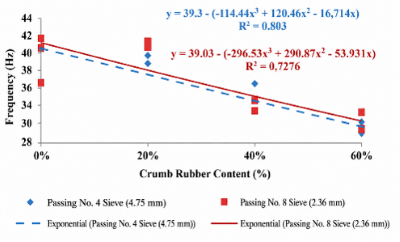
This study investigated the effect of waste tire crumb rubber on the damping characteristics of mortar for masonry wall applications using the free vibration method. Beam specimens measuring 500 mm × 100 mm × 100 mm were prepared with different crumb rubber contents and two particle sizes, namely passing the No. 4 (4.75 mm) and No. 8 (2.36 mm) sieves. Free vibration tests were conducted using a cantilever beam configuration with a 15 N suspended load. The acceleration responses were recorded using a piezoelectric accelerometer connected to the Dewesoft data acquisition system and analyzed using the Fast Fourier Transform (FFT) and logarithmic decrement methods to determine the natural frequency and damping ratio. The results showed that increasing the crumb rubber content enhanced the damping ratio while reducing the natural frequency of the mortar specimens. The highest damping ratio of 4.16% was obtained for the specimen containing 60% crumb rubber passing the No. 4 sieve. These findings demonstrated that waste tire crumb rubber effectively improved vibration energy dissipation and showed considerable potential as a sustainable material for enhancing the dynamic performance of masonry mortar.
Downloads
References
[1] R. W. Clough and J. Penzien, Dynamics of Structures, 3rd ed. Berkeley, CA, USA: Computers & Structures Inc., 2003.
[2] A. K. Chopra, Dynamics of Structures: Theory and Applications to Earthquake Engineering, 5th ed. Upper Saddle River, NJ, USA: Pearson, 2017.
[3] H. Chen, C. Liang, Y. Fu, Y. Zhang, and X. Li, “Damping characteristics of mortar prepared from recycled brick fine aggregate impregnated with polymer emulsion,” Acta Materiae Compositae Sinica, vol. 42, no. 9, pp. 5135–5149, 2025, doi: 10.13801/j.cnki.fhclxb.20241119.004.
[4] H. Chen, Y. Fu, B. Jin, Y. Zhang, and X. Li, “Enhancing energy dissipation in mortar utilizing recycled brick fine aggregate impregnated with polymer emulsion under uniaxial cyclic loading,” Journal of Building Engineering, vol. 97, Art. no. 110857, 2024, doi: 10.1016/j.jobe.2024.110857.
[5] Y. Seong, S. T. Kim, M. K. Jo, J. H. Lee, and J. S. Kim, “Evaluation of impact sound insulation performance in composite floor systems incorporating viscoelastic damping mortar,” Journal of the Korea Institute of Building Construction, vol. 25, no. 2, pp. 149–160, 2025, doi: 10.5345/JKIBC.2025.25.2.149.
[6] ASTM International, ASTM E756-05: Standard Test Method for Measuring Vibration-Damping Properties of Materials. West Conshohocken, PA, USA: ASTM International, 2005.
[7] C. K. V. Chandan, Experimental Investigation of Damping Characteristics of Engineering Materials Using ASTM E756, 2016.
[8] Y. Gu, Experimental Study on Dynamic Characteristics of Beam Structures, 2015.
Downloads
Published
Issue
Section
License
Copyright (c) 2025 Multilawati Nasution

This work is licensed under a Creative Commons Attribution 4.0 International License.