
Construction of Clean Water Supply and Ablution Facilities at Al-Ikhlas Mosque
DOI:
https://doi.org/10.24036/r8fw3x71Keywords:
Ablution Facility, Clean Water Supply, Community Service, Rural MosqueAbstract
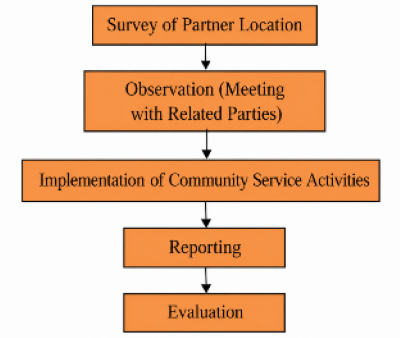
Padang Baru Jorong in Nagari Ganggo Hilia, Bonjol District, Pasaman Regency, is a rural settlement of approximately 30 households that is not served by a municipal water pipeline. Al-Ikhlas Mosque had relied on a shallow dug well with visually poor water quality, and the congregation had to draw water manually with a bucket because no permanent ablution facility was available. This community partnership activity aimed to provide a functional water-supply system and construct an accessible ablution facility for the mosque congregation and nearby residents. The program was implemented through field observation, coordination with local authorities and mosque managers, technical design and budgeting, procurement of materials, and 32 hours of construction work involving lecturers, students, and community members. The completed works included a water pump, a 500 L storage tank supported by a 2.5 m steel tower, PVC distribution pipes, a roofed ablution structure, and water faucets. The system conveyed water from the well to the storage tank and distributed it by gravity to the ablution points. The activity reduced the need for elderly congregants to lift water manually and improved the availability and convenience of water for worship. The project shows that a simple, community-based water installation can address basic service limitations in an unserved rural mosque
Downloads
References
[1]. World Health Organization, Guidelines for Drinking-water Quality: Fourth Edition Incorporating the First and Second Addenda. Geneva, Switzerland: WHO, 2022.
[2]. United Nations Children’s Fund and World Health Organization, Progress on Household Drinking Water, Sanitation and Hygiene 2000–2022: Special Focus on Gender. New York, NY, USA: UNICEF and WHO, 2023.
[3]. World Health Organization, Guidelines for Drinking-water Quality: Small Water Supplies. Geneva, Switzerland: WHO, 2024.
[4]. World Health Organization, Sanitary Inspection Packages: A Supporting Tool for the Guidelines for Drinking-water Quality: Small Water Supplies. Geneva, Switzerland: WHO, 2024.
[5]. UNESCO, The United Nations World Water Development Report 2024: Water for Prosperity and Peace. Paris, France: UNESCO, 2024.
[6]. Republic of Indonesia, Ministry of Health Regulation No. 2 of 2023 concerning the Implementing Regulation of Government Regulation No. 66 of 2014 on Environmental Health, Jakarta, Indonesia, 2023.
[7]. Republic of Indonesia, Government Regulation No. 122 of 2015 concerning Drinking Water Supply Systems, Jakarta, Indonesia, 2015.
[8]. Ministry of Public Works and Housing of the Republic of Indonesia, Regulation No. 27/PRT/M/2016 concerning the Implementation of Drinking Water Supply Systems, Jakarta, Indonesia, 2016.
[9]. Badan Standardisasi Nasional, SNI 8153:2015, Sistem Plambing pada Bangunan Gedung. Jakarta, Indonesia: BSN, 2015.
[10]. A. V. M. Machado, P. A. D. Oliveira, P. G. Matos, and A. S. P. Santos, “Strategies for achieving sustainability of water supply systems in rural environments with community management in Brazil,” Water, vol. 15, no. 12, Art. no. 2232, 2023, doi: 10.3390/w15122232.
[11]. T. D. Toan, D. N. Hanh, and D. T. Thu, “Management models and the sustainability of rural water supply systems: An analytical investigation in Ha Nam Province, Vietnam,” Sustainability, vol. 15, no. 12, Art. no. 9212, 2023, doi: 10.3390/su15129212.
[12]. A. A. S. Al Alawi, P. K., G. Kumarasamy, and K. S. Al Kaabi, “Assessment of ablution water consumption in mosques,” in Proc. Int. Conf. Civil Infrastructure and Construction, 2023, pp. 1260–1265, doi: 10.29117/cic.2023.0155.
[13]. E. Afiatun, S. Wahyuni, and J. Harto, “Study of potential utilization of recycling ablution used water: Case study at Ulul Albaab Mosque, Universitas Pasundan, Bandung, Indonesia,” J. Community Based Environmental Engineering and Management, vol. 6, no. 2, pp. 111–118, 2022, doi: 10.23969/jcbeem.v6i2.6150.
[14]. U. Kadaria, “Study of rainwater potential as raw water source for campus mosque at Engineering Faculty of Tanjungpura University,” Jurnal Presipitasi: Media Komunikasi dan Pengembangan Teknik Lingkungan, vol. 19, no. 3, pp. 477–486, 2022, doi: 10.14710/presipitasi.v19i3.477-486.
[15]. M. A. Hurayra, A. Ahmed, M. A. Alim, and A. Rahman, “Water savings in places of worship: A case study for St Mary’s Mosque in Australia,” Sustainability, vol. 16, no. 15, Art. no. 6568, 2024, doi: 10.3390/su16156568.
Downloads
Published
Issue
Section
License
Copyright (c) 2025 Muvi Yandra, Totoh Andayono, Yuwalitas Gusmareta, Henny Yustisia

This work is licensed under a Creative Commons Attribution 4.0 International License.