
BIM-Based Quantity Take-off for Reinforced Concrete Structure Works in Educational Building Construction Project
DOI:
https://doi.org/10.24036/59ea1946Keywords:
Building Information Modeling (BIM), Quantity Take-off, Autodesk Revit, Structural Work, Construction Cost EstimationAbstract
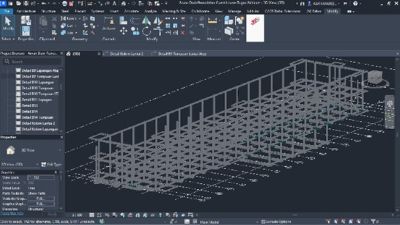
The use of Building Information Modeling (BIM) in Indonesia is still limited and not yet common. One of the benefits of Building Information Modeling (BIM) is to improve efficiency in calculating the amount of work. Quantity Take-off calculations are often done conventionally by measuring shop drawings manually, which can lead to errors due to inaccuracies and complexities in calculating the volume of work. One software that can assist in designing, simulating, and visualizing buildings is Autodesk Revit software. The calculation process is done by converting 2D Detailed Engineering Design (DED) drawings into 3D drawings using Revit 2024 software. The case study of this research is the Construction Project of the Guest House Building at the University of Riau, Pekanbaru City, Riau Province. The research process involves modeling based on references from shop drawings, followed by performing quantity take-off calculations on the building structure work. The output of the modeling shows the results of calculating the volume of concrete needed for the building structure and the quantity of steel reinforcement from the building structure. Based on the calculation results, the volume of concrete needed for the conventional method is 391.197 m3, which when multiplied by AHSP results in a total cost of Rp 762,376,997.19. Meanwhile, the total volume using Autodesk Revit 2024 is 318,213 m3 with a total cost of Rp 620,942.778,00. For the reinforcement work of the structure, the Autodesk Revit calculation results in Rp 1,952.501.845,31, while the results from the conventional method amount to Rp 3,697.279.792,12. It can be concluded that the calculation results using Building Information Modeling (BIM) method are smaller than the calculations using the conventional method.
Downloads
References
[1] S. Alathamneh, W. Collins, and S. Azhar, “BIM-based quantity takeoff: Current state and future opportunities,” Automation in Construction, vol. 165, Art. no. 105549, 2024, doi: 10.1016/j.autcon.2024.105549.
[2] A. Wahab and J. Wang, “Factors-driven comparison between BIM-based and traditional 2D quantity takeoff in construction cost estimation,” Engineering, Construction and Architectural Management, vol. 29, no. 2, pp. 702–715, 2022, doi: 10.1108/ECAM-10-2020-0823.
[3] Republic of Indonesia, Law of the Republic of Indonesia No. 2 of 2017 concerning Construction Services, Jakarta, Indonesia, 2017.
[4] Ministry of Public Works and Housing of the Republic of Indonesia, Regulation No. 22/PRT/M/2018 concerning State Building Construction, Jakarta, Indonesia, 2018.
[5] A. Monteiro and J. P. Martins, “A survey on modeling guidelines for quantity takeoff-oriented BIM-based design,” Automation in Construction, vol. 35, pp. 238–253, 2013, doi: 10.1016/j.autcon.2013.05.005.
[6] D. Olsen and J. M. Taylor, “Quantity take-off using Building Information Modeling (BIM), and its limiting factors,” Procedia Engineering, vol. 196, pp. 1098–1105, 2017, doi: 10.1016/j.proeng.2017.08.067.
[7] J. Choi, H. Kim, and I. Kim, “Open BIM-based quantity take-off system for schematic estimation of building frame in early design stage,” Journal of Computational Design and Engineering, vol. 2, no. 1, pp. 16–25, 2015, doi: 10.1016/j.jcde.2014.11.002.
[8] S. Yun and S. Kim, “Basic research on BIM-based quantity take-off guidelines,” Architectural Research, vol. 15, no. 2, pp. 103–109, 2013, doi: 10.5659/AIKAR.2013.15.2.103.
[9] E. Plebankiewicz, K. Zima, and M. J. Skibniewski, “Analysis of the first Polish BIM-based cost estimation application,” Procedia Engineering, vol. 123, pp. 405–414, 2015, doi: 10.1016/j.proeng.2015.10.064.
[10] S.-K. Lee, K.-R. Kim, and J.-H. Yu, “BIM and ontology-based approach for building cost estimation,” Automation in Construction, vol. 41, pp. 96–105, 2014, doi: 10.1016/j.autcon.2013.10.020.
[11] K. Zima, “Impact of information included in the BIM on preparation of bill of quantities,” Procedia Engineering, vol. 208, pp. 203–210, 2017, doi: 10.1016/j.proeng.2017.11.039.
[12] S. Kim, S. Chin, and S. Kwon, “A discrepancy analysis of BIM-based quantity take-off for building interior components,” Journal of Management in Engineering, vol. 35, no. 3, Art. no. 05019001, 2019, doi: 10.1061/(ASCE)ME.1943-5479.0000684.
[13] C. Khosakitchalert, N. Yabuki, and T. Fukuda, “Improving the accuracy of BIM-based quantity takeoff for compound elements,” Automation in Construction, vol. 106, Art. no. 102891, 2019, doi: 10.1016/j.autcon.2019.102891.
[14] H. Liu, J. C. P. Cheng, V. J. L. Gan, and S. Zhou, “A knowledge model-based BIM framework for automatic code-compliant quantity take-off,” Automation in Construction, vol. 133, Art. no. 104024, 2022, doi: 10.1016/j.autcon.2021.104024.
[15] M. Valinejadshoubi, O. Moselhi, I. Iordanova, F. Valdivieso, and A. Bagchi, “Automated system for high-accuracy quantity takeoff using BIM,” Automation in Construction, vol. 157, Art. no. 105155, 2024, doi: 10.1016/j.autcon.2023.105155.
Downloads
Published
Issue
Section
License
Copyright (c) 2025 Arvan Dani, Risma Apdeni, Zel Citra

This work is licensed under a Creative Commons Attribution 4.0 International License.